Red or blue bonus
Crazy Time Coin Flip
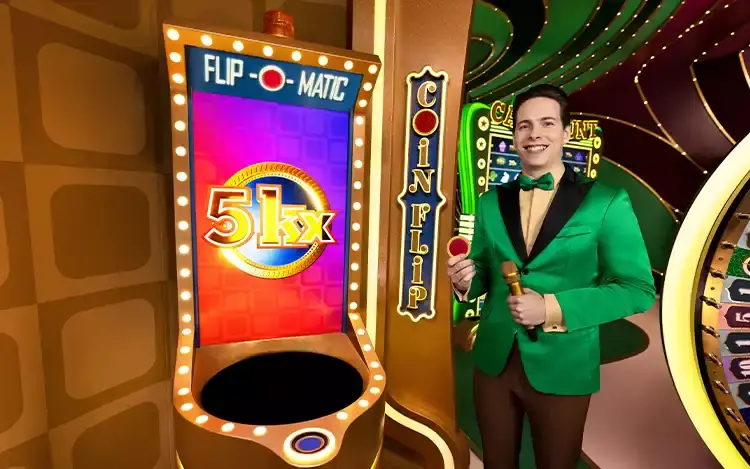
See how Coin Flip works in Crazy Time: two generated multipliers, one red side, one blue side, a coin lands on the winning side and the same random outcome settles every participant.
 Crazy Time UK
Red or blue bonus
See how Coin Flip works in Crazy Time: two generated multipliers, one red side, one blue side, a coin lands on the winning side and the same random outcome settles every participant.
Sides
2
Choice
None
Reveal
Shared
Rescue
Feature
Round position
Watch for Coin Flip when the main Crazy Time wheel stops on one of its four Coin Flip segments. On the 54-segment layout, that is 4 of 54 positions, or about 7.41% per spin before the usual short-sample noise of a live game show.
The bonus is the quickest of the four. Everyone with an active Coin Flip bet moves into the same broadcast round, the coin podium opens, and the result is shared. Unlike Cash Hunt, there is no individual target, personal board or separate reveal for different players.
Binary reveal
Before the flip, Crazy Time generates two multipliers and assigns one to each face of the coin. One value sits on the red side, one value sits on the blue side, and both are visible before the coin moves.
The coin lands, the winning side is shown, and stakes on the Coin Flip bet spot are settled at that multiplier. The structure is simple, but it still has one important boundary: seeing both values before the flip does not make the landing side readable.
| Moment | What happens | Player control |
|---|---|---|
| Trigger | The wheel stops on a Coin Flip segment. | Bet already placed |
| Assign | Two generated multipliers attach to red and blue. | Watch only |
| Flip | The coin lands on one side. | No input |
| Settle | The winning side pays every participant. | Result shared |
Streak boundary
Ask the streak question directly: red has landed several times, so is blue more likely next? No. Each Coin Flip result is independent, and the coin has no memory of the finished sequence.
A run of red or blue is still useful to record because it explains what happened in the session. It is not a force acting on the next flip, and it is not a trick. The Crazy Time predictor keeps that same boundary: trend views can describe a sample, but they do not turn past colour into a next-round signal.
The rescue feature also belongs in this boundary. It is a safeguard described in source material, but source wording differs on the exact trigger condition. For that reason, the exact threshold is left to the in-game help instead of being presented as a fixed public number here.
Data boundary
Use Crazy Time statistics to follow recent Coin Flip triggers, settled multipliers and gaps between appearances. Because Coin Flip has four wheel segments, its rows usually build faster than Cash Hunt, Pachinko and the named Crazy Time bonus, but short live windows can still look uneven.
For the wider probability context, the RTP and wheel segments page keeps the 54-segment layout and return figures in one place. For practice without real-money stakes, the mobile demo lets players feel how quickly the red-blue reveal resolves.
Quick answers
Two generated multipliers appear, one on the red side and one on the blue side. The coin flips, the side that lands face up is the winning side, and everyone in the round receives the same multiplier.
The red or blue result is a random outcome with no memory of previous flips. Player action does not change which side lands.
No. Colour streaks describe finished rounds only, and no row of previous results makes the next red or blue outcome more likely.
If each side is treated as an independent 50/50 event, seven of one named side in a row is 1 in 128. Seven of either side as a colour run is 1 in 64. That maths is a record explanation, not a forecast.
It is a safeguard that can re-run the flip when the initial result is at the lowest end of the scale. The exact trigger should be checked in the in-game help because source wording differs.
Coin Flip has 4 of 54 wheel segments, so the layout probability is about 7.41% per spin, or roughly one trigger every 13 to 14 spins over a long sample.
Source check
Coin Flip mechanics are checked against source material before being reduced to the short facts on this page.
Supports the four bonus games and the red-blue Coin Flip mechanic.
Evolution pageSupports segment counts and published rule language used for probability context.
Rules PDFUse the bonus hub for side-by-side comparison with Cash Hunt, Pachinko and the named Crazy Time bonus.
Bonus overviewSeparated action
Coin Flip feels decisive because the result lands quickly, but the short format does not make it readable. Treat red-blue history as session context, use safer gambling tools and set a deposit limit before playing.
For mechanics-first reading, compare the four bonus games before moving from demo practice to real-money play.