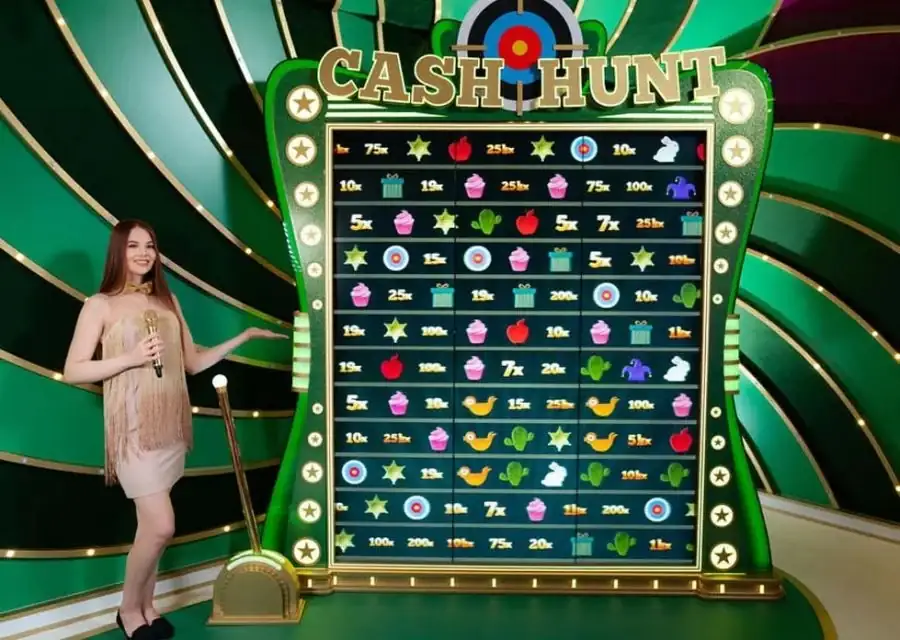
Cash Hunt Crazy Time
Cash Hunt is the Crazy Time target-pick bonus round: aim at one covered symbol, reveal a hidden multiplier, and settle the payout on your active Cash Hunt bet.
Cash Hunt is a Crazy Time bonus round where the main wheel triggers a target board, the player picks one covered symbol, and the hidden multiplier behind that pick decides the bonus payout. It is one of four Crazy Time bonus rounds, alongside Coin Flip, Pachinko, and Crazy Time Bonus, and it sits on two of the 54 main wheel segments (listed; pending fact check). The cash hunt, cash hunt crazy time, crazy time cash hunt, cash hunt game, and cash hunt bonus round queries all return this feature. The how does cash hunt bonus round work and cash hunt bonus round how it works queries want the step flow covered just below. The crazy time cash hunt 50x and cash hunt 50x queries want a revealed-value example, framed as one possible reveal rather than a target users can aim for.
Cash Hunt Crazy Time Snapshot
- Bonus round type
- Crazy Time pick feature on a target board
- Target pick
- Choose one covered symbol with the cannon (or auto pick)
- Hidden multiplier
- Each target hides a randomised value, revealed after the pick
- Wheel share (listed)
- 2 of 54 segments, pending fact check
- Can a target position be read?
- No. Position, shape, and recent reveals do not signal value
| Field | Value |
|---|---|
| Feature type | Crazy Time bonus round (target pick) |
| Trigger source | Main wheel lands on Cash Hunt with an active Cash Hunt bet |
| Listed wheel segments | 2 of 54 (about 3.70% theoretical share, pending fact check) |
| Target board | Covered symbols, commonly listed as 108 targets (pending fact check) |
| Pick action | Aim cannon at one target within a short timer, or use auto pick |
| Reveal type | Hidden multiplier behind the selected target |
| Listed RTP | About 95.27% (pending provider confirmation) |
| Listed max multiplier | Conflicting local notes (pending provider confirmation) |
| Fact status | Numerical claims pending Evolution / approved fact-file confirmation |
- Covered Symbol
- 108 covered icons across a wall layout (listed; pending fact check)
- Selected Symbol
- One target chosen by cannon aim or auto pick
- Reveal Multiplier
- Hidden value flips up after the cannon fires
- No Edge Note
- Corner, centre, edge, row, and repeated-icon picks all carry randomised values
- Note
- Visual aid only. Position and shape do not expose hidden multiplier value.
Cash Hunt is the most directly interactive of the four Crazy Time bonus rounds. The base wheel pays the number tiles 1, 2, 5, and 10; the bonus tiles pause base play and hand the round to a feature. Cash Hunt is the feature where the player aims a cannon, picks one covered target, and reveals a hidden multiplier. Coin Flip, Pachinko, and Crazy Time Bonus sit alongside it as the other three features.
What Cash Hunt Is
Cash Hunt is a pick feature on a target wall. Local source notes commonly list 108 covered targets (pending fact check), each hiding a randomised multiplier. The cannon is the user input; the reveal is the result. The shuffle is independent of the layout, so target position is decoration, not signal. The crazy time cash hunt bonus round and how does cash hunt bonus round work queries want this short answer first, then the step flow.
Why Players Search It
Two reasons drive the search volume. The first is the interaction: Cash Hunt is the only round where the player chooses a target, and that pick feels like control. The second is the multiplier reveal: 50x and higher values appear in clips, and players want to know what the ceiling and floor look like. Cash Hunt strategy and crazy time cash hunt trick queries usually arrive looking for an edge that does not exist.
What This Page Covers
This page owns the Cash Hunt mechanic: rules, the target board, the hidden multipliers, latest results, listed frequency and RTP, strategy and trick checks, the comparison with Pachinko, and access notes. Full bonus-round comparison sits on all bonus rounds , and base-game settlement sits on Crazy Time rules . RTP math, observed frequency, and big wins each have their own page, linked in the relevant section below.
- Trigger
- Main wheel lands on Cash Hunt; active Cash Hunt bet required
- User Action
- Aim cannon at one target on the covered wall, or use auto pick
- Reveal
- Hidden multiplier flips up after the cannon fires
- Payout
- Revealed multiplier applies to the original Cash Hunt stake
- Route Next
- Open all bonus rounds for the full feature comparison
- Note
- Five fields, one routing path. Full feature mechanics covered in the sections below.
How Cash Hunt Works
The how does cash hunt bonus round work, cash hunt bonus round how it works, and crazy time cash hunt bonus round queries want a clean step flow. Cash Hunt has four phases: the wheel trigger, the target selection, the multiplier reveal, and the payout settlement. Each phase has a fixed input and a fixed output, and the sequence is identical every time the round runs.
Wheel Trigger
The user must place a Cash Hunt bet before the bet lock. The host calls no-more-bets, the bet window closes, the Top Slot rolls, and the main wheel spins. If the pointer stops on the Cash Hunt segment and the user held an active bet on that segment, the feature triggers. If the user did not back Cash Hunt, the feature still runs visually for active bettors at the table, but no Cash Hunt payout reaches the missed bet. Watching is fine; backing the segment is the only path to a Cash Hunt result.
Target Selection
After the trigger, the studio cuts to the target board. A wall of covered symbols appears, the cannon sits below, and a short selection timer counts down. The user aims at one target and fires, or the auto pick fires for users who do not select within the timer. Only one target reveal pays; subsequent reveals shown for the table are visual reference, not extra picks.
Multiplier Reveal
The chosen target lifts to show the hidden multiplier behind it. Each target carries a value generated for that round; the layout does not lock to a fixed position-to-value map. The reveal is the round outcome. A high reveal in one round does not change the next round’s board, since the next round generates a new shuffle.
Payout Settlement
The revealed multiplier applies to the original Cash Hunt stake. Top Slot can multiply the result only when the Top Slot segment reel matched Cash Hunt before the spin and the user held the matching active bet. Settlement updates the result panel with the multiplier and the win, and the next round’s bet window opens. Full base-game settlement detail sits on round rules , and wheel segments covers the main wheel layout.
-
Bet Cash Hunt
Place chips on the Cash Hunt segment before the bet lock
-
Wheel spin
Top Slot rolls; main wheel spins against the fixed pointer
-
Cash Hunt lands
Pointer stops on Cash Hunt; feature triggers for active bets only
-
Target board opens
Covered wall of symbols appears; selection timer starts
-
Target pick
User aims cannon and fires, or auto pick fires at timeout
-
Multiplier reveal
Chosen target lifts; hidden multiplier displays
-
Payout settles
Revealed multiplier applies to the Cash Hunt stake; Top Slot stacks if matched
- Top Slot Match
- Segment reel must match Cash Hunt before the wheel spin
- Bonus Trigger
- Bet must be active on Cash Hunt for the multiplier to attach
- Payout Note
- If matched, the Top Slot multiplier multiplies the revealed Cash Hunt value
- No Prediction
- Top Slot is RNG-driven; the segment reel does not forecast which tile lands
- Note
- Top Slot does not predict the Cash Hunt landing; it only multiplies a matching active bet.
Cash Hunt Rules
The cash hunt rules and cash hunt rules and regulations queries want the bet timing, the valid-bet definition, the settlement path, and the operator-side limits, kept short. Full regulator framing belongs on the responsible gambling page; the rules below are the in-game mechanics.
Bet Timing
The bet must be placed before the round locks. The bet window runs for about 12 to 15 seconds, the host calls no-more-bets, and chips placed after the lock do not count. A late click is a missed round, even if the wheel later lands on Cash Hunt. The window is a hard cut, and the bet lock applies to every segment, not only Cash Hunt.
Valid Cash Hunt Bet
A Cash Hunt result pays only when the main wheel lands on Cash Hunt and the user backed that segment with chips before the lock. Number bets do not convert into a Cash Hunt entry; only the Cash Hunt chip stack triggers the feature for that user. If the user backed only number tiles, the round runs but no Cash Hunt payout reaches that user, even when the feature plays out for the table.
Result Settlement
The feature result is the revealed multiplier behind the chosen target. Settlement applies that multiplier to the Cash Hunt stake. Top Slot stacks on top of the revealed multiplier when the segment reel matched Cash Hunt before the spin. Settlement is automatic and updates the result panel with the multiplier and the win.
Rule Limits
Min bet, max bet, autoplay limits, and table limits vary by operator and by GEO. Crazy Time rules note the in-game flow; deposit, withdrawal, and bonus terms sit on the casino side. Operator-side caps may also apply to a single Cash Hunt payout in some jurisdictions, and live-game eligibility for promotional offers can vary. For approved Cash Hunt rules and operator casino availability , the linked pages cover the GEO layer.
| Step | Check | Note |
|---|---|---|
| 1 | Bet locked before timer end | Chips placed during the open window count; late clicks do not |
| 2 | Wheel landed on Cash Hunt | Number tiles do not trigger the feature |
| 3 | Pick registered (manual or auto) | If the timer ends without a pick, auto pick selects a target |
| 4 | Multiplier revealed | Chosen target lifts; the hidden value displays |
| 5 | Payout settled | Revealed multiplier applies to the Cash Hunt stake; Top Slot stacks if matched |
| 6 | Operator limits applied | Min bet, max bet, autoplay, and any payout cap follow operator and GEO rules |
Cash Hunt Target Board and Hidden Multipliers
The target board is the visual layer of Cash Hunt: a covered wall of symbols, a cannon, a single pick, a single reveal. This section owns the board detail, since all bonus rounds only summarises it. The cash hunt game and crazy time cash hunt queries usually want the board detail near the top of the page.
Covered Targets
Local source notes commonly describe a wall with many covered symbols. The most cited figure is 108 targets (pending fact check). Each target shows a decorative icon on the front; the multiplier sits hidden behind it. The icons repeat across rounds (stars, hearts, gems, and other show-themed shapes), but the multiplier shuffle changes per round. The board layout is fixed in shape, not in value.
Hidden Values
Hidden multipliers are unknown before the reveal. The values cover a wide spread, from low single-digit multipliers up to higher ceiling values that vary by source notes. The shuffle is independent of icon shape and target position. A 5x and a 500x can sit next to each other; a corner target can carry a low or a high value.
Manual Pick vs Auto Pick
Manual pick uses the cannon: aim, fire, reveal. Auto pick uses a default target if the user does not choose within the timer. The probability behind both options is the same shuffled spread; auto pick is a convenience for users who miss the timer, not a different math. A user who picks every round and a user who lets auto pick fire face identical odds across long runs.
Why Location Does Not Prove Value
Corner picks, centre picks, edge rows, and repeated icons do not expose hidden multiplier value. The shuffle randomises the layout per round, so a corner target on this round can carry a 3x, and the same corner target on the next round can carry a 200x. Streamer pick clips show the same target patterns, but those clips are skewed by survivor bias. A streamer hitting a 50x or higher reveal on a corner pick is not a copyable edge; most rounds settle at modest values, and the high-reveal clips circulate more than the average ones.
- Covered Targets
- Wall of covered symbols, commonly listed as 108 (pending fact check)
- Selected Target
- One target chosen by cannon aim or auto pick
- Hidden Multiplier
- Randomised value behind the chosen target
- Reveal State
- Target lifts after the cannon fires; multiplier displays
- Fact Status
- Target count and value spread pending provider confirmation
- Note
- Layout is fixed in shape; multipliers shuffle independently per round.
| Option | What the user does | What changes | What does not change |
|---|---|---|---|
| Manual pick | Aim cannon and fire within the timer | User selects which target lifts | The hidden multiplier shuffle is identical |
| Auto pick | Let the timer expire; default target fires | Convenience: no input needed | Same randomised value spread; same probability |
Cash Hunt Multipliers and 50x Hits
Cash Hunt is searched with multiplier examples, and 50x is the most common one. The crazy time cash hunt 50x, cash hunt 50x, and 50x cash hunt queries want a value example, framed correctly. 50x is one possible reveal among many, not a target the user can aim for.
Common Multiplier Range
Local source notes describe a multiplier spread that runs from low single-digit values up to higher ceiling values. The most cited reveals are in the 5x to 100x band; the lower end is more common, the higher end is rarer. Each round generates a new spread, so the visible distribution can shift between rounds. The bonus round RTP context for these spreads sits on bonus round RTP .
50x Cash Hunt Hits
50x is a revealed-value example. It is not a position on the board, not a symbol shape, and not a default outcome. A 50x reveal can land on any target, since the shuffle is independent of icon and position. Treating 50x as a target leads to false expectations: the reveal is the random output of the chosen pick, not a value the user steered toward.
Higher Multiplier Claims
Local competitor notes conflict on Cash Hunt’s max multiplier. Some sources list ceilings well above the 50x band; others list lower figures. The conflict is a local-source issue, and the figure is pending provider confirmation. For verified record-style payouts, Cash Hunt big wins holds the date and source qualifiers. A high reveal in one round does not change the next round’s board, since each round generates a new shuffle.
| Revealed value | User meaning | Fact status | Caveat |
|---|---|---|---|
| 5x to 25x | Lower-end reveal; most common band in clips | Listed; pending fact check | Common output, not a guaranteed minimum |
| 50x | Mid-band reveal example | Listed example, not a target | Cannot be aimed for; pick chooses a target, not a value |
| 100x to 500x | Higher reveals visible in some clips | Listed; pending fact check | Less common; not a copyable pick pattern |
| Higher ceiling | Conflicting local notes; figures vary by source | Pending provider confirmation | Treat as listed value, not promised win |
Cash Hunt Latest Results
Users searching cash hunt latest, cash hunt result, and crazy time cash hunt today want the most recent feature hits. This section is a teaser, since the live data lives on the Cash Hunt tracker and the Cash Hunt results log. Crazy time tracking is reading past rounds, not forecasting the next one.
Latest Cash Hunt Hit
A teaser shows the time of the last Cash Hunt landing, the revealed multiplier, the Top Slot match status, and the selected sample window. Recent results are descriptive: a Cash Hunt hit fifteen minutes ago is a past round, not a signal for the next round. The wheel runs an independent draw on every spin.
Selected Window
Sample windows on the tracker layer cover the last hour, the last 24 hours, and longer ranges. A 24-hour window may show ten to twenty Cash Hunt landings, which sits within the expected variance for a 2/54 segment share. Tracksino-style frequency views cover the same observed numbers in different layouts; treat each window as descriptive only.
What Results Can and Cannot Show
Past Cash Hunt results show what happened, not what comes next. A long gap without Cash Hunt is normal variance, not a due signal; even a 50-spin gap sits within expected behaviour for a 2/54 segment. Recent reveal values do not constrain the next round’s reveal, since the next board generates a new shuffle. For the no-prediction note in full, prediction limits covers the predictor and signal-group angle.
- Last Seen
- Time of the most recent Cash Hunt landing
- Revealed Multiplier
- Hidden multiplier behind the chosen target on that round
- Top Slot Match
- Whether Top Slot matched on that spin
- Sample Window
- Selected window: last hour, last 24 hours, or longer range
- Data Status
- Tracker view; updates per round
- Deeper Url
- /tracker/
- Note
- Past round data updates with each new spin. Past data is descriptive, not predictive.
- Shows History
- Recent Cash Hunt landings, revealed multipliers, and Top Slot match status
- Shows Frequency
- Selected sample window hit count vs theoretical share
- Does Not Predict
- No method reads the next Cash Hunt landing or the next reveal value
- Note
- Each spin is an independent RNG draw. Past data is descriptive only.
Cash Hunt Frequency, RTP, and Volatility
Three data fields cover the math users expect on a Cash Hunt page: theoretical frequency by segment, listed RTP, and the volatility profile. Deeper math sits on Cash Hunt RTP and Cash Hunt frequency . The fact rule applies: numerical claims are listed values pending provider confirmation.
Listed Segment Frequency
Local source notes commonly list Cash Hunt as two segments out of 54 on the main wheel (pending fact check). That gives a theoretical share of about 3.70% per spin, or roughly one Cash Hunt landing every 27 spins on long-run math. Theoretical frequency comes from segment count, not recent results. Observed frequency in selected sample windows can drift from the theoretical share, especially over short runs of a hundred spins or fewer.
Cash Hunt RTP
Local source notes list Cash Hunt RTP at about 95.27% (pending provider confirmation). The figure sits within the bonus-round RTP band described on bonus round RTP , with Coin Flip listed slightly higher and Pachinko and Crazy Time Bonus listed slightly lower. RTP is long-run math, not a session promise. A 95.27% RTP does not mean a single Cash Hunt round returns 95.27% of the stake; it means the long-run average across many rounds settles near that figure.
Volatility Profile
Cash Hunt volatility is medium to high in competitor framing. The 108-target spread (listed; pending fact check) covers a wide range of values, so a single pick can land anywhere on the spread. Most reveals sit in the lower-to-middle band; a smaller share lands at the higher end. The result is a feature with frequent modest payouts and occasional large ones, which fits a medium-to-high volatility profile.
- Listed Segments
- 2 of 54 (listed; pending fact check)
- Listed Probability
- About 3.70% theoretical share per spin
- Rough Frequency
- About one Cash Hunt landing every 27 spins on long-run math
- Observed Window Url
- /stats/
- Fact Status
- Pending provider confirmation
- Note
- Theoretical frequency by segment count; observed runs drift in short samples.
- RTP Status
- Listed at about 95.27% (pending provider confirmation)
- Volatility Label
- Medium to high
- Typical Result Note
- Most reveals sit in the lower-to-middle multiplier band
- Higher Result Note
- Higher reveals (50x+ examples) appear in some clips; not a target the player can aim for
- Note
- RTP is long-run math, not a session promise. Volatility describes swing, not edge.
Cash Hunt Strategy and Tricks
Cash Hunt strategy and crazy time cash hunt strategy queries arrive in two shapes. The first asks how to manage stake and session risk; that is the right question. The second asks how to read the target board for an edge; that question has no honest answer. The cash hunt trick, crazy time cash hunt trick, and cash hunt 50x trick queries usually mean the second shape, and the section below rejects the trick angle directly.
What Strategy Can Mean
Strategy on Cash Hunt is bet sizing, session control, and risk shape. The user can choose whether to bet on Cash Hunt at all, how much to stake, and when to stop. Demo first is a useful step for first-session players. Small stakes first is a useful default until the round timer and the cannon input feel familiar. Bonus-focused stake plans across all four features sit on bonus-focused strategy .
Target Pick Tricks
Tricks based on target position, symbol shape, repeated icons, streamer picks, and long-gap timing do not improve probability. The hidden multipliers shuffle independently of position and icon. Corner picks, centre picks, edge rows, and repeated symbols across rounds carry randomised values. Streamer picks are content, not method: a clip showing a 200x reveal on a centre pick is one outcome, not a copyable edge. A long gap without Cash Hunt does not make Cash Hunt due; the wheel has no memory. Auto pick is a convenience option, not a different probability. Top Slot does not predict the Cash Hunt landing or the reveal value; it only multiplies a matching active bet.
Safer Session Habits
Demo first is the safest entry. Small stakes first while learning the timer and the cannon input keeps early-session swings small. Avoid chasing after a long gap; treat the gap as variance, not as a build-up to a guaranteed bonus. Stop after a planned session limit. UK players should also note GAMSTOP self-exclusion, GamCare, and BeGambleAware as session-control tools at UKGC-licensed operators. The full anti-prediction note sits on prediction limits , and the practice route is Cash Hunt demo .
| Claim | Why players believe it | Safer reading |
|---|---|---|
| Corner picks pay more | Visual edge of the wall stands out in clips | Corner targets carry randomised values; position has no edge |
| Centre picks hit the highest multiplier | Headline reveals tend to be filmed centrally | Position is irrelevant to the hidden value behind a target |
| A repeated symbol across rounds is luckier | Symbols repeat across plays; memory bias | Icon shape is decoration; values shuffle independently per round |
| Streamer picks are a copyable edge | Survivor bias: only winning clips circulate | Most picks settle in the lower band; clips skew toward big wins |
| Cash Hunt is due after a long gap | Pattern-seeking after a drought | Each spin is independent; a 50-spin gap is normal variance |
| Signal groups know the next reveal | Authority bias from paid signal sellers | No public method reads the shuffle or the next wheel landing |
- User Goal
- Try Cash Hunt with controlled exposure
- Risk Fit
- Medium to high volatility; expect modest reveals more often than headline ones
- Safer Action
- Small stakes first; demo first; planned session limit; no chasing
- Next Page
- bonus-focused strategy for stake-allocation models across all four features
- Note
- Session fit describes risk shape, not winning advice. Each spin remains independent.
Cash Hunt vs Pachinko
Cash Hunt and Pachinko sit at the same wheel-segment count (2 of 54, listed; pending fact check) but feel different to play. The crazy time cash hunt bonus round comparison and pachinko vs cash hunt queries usually want the side-by-side. Full Pachinko detail sits on Pachinko ; the comparison below is short.
Pick Reveal vs Puck Drop
Cash Hunt is target selection and reveal: the user aims, fires, and one hidden multiplier flips up. Pachinko is puck drop through pegs: the host releases the puck from the top, it bounces through pegs, and the slot at the base sets the multiplier. Two different visual mechanics, two different result reveals.
Interaction Difference
Cash Hunt feels more directly interactive because the user chooses a target. Pachinko feels more physics-driven and watchable, since the puck path is the show and the player has no input during the drop. Both feel different, but the user input on Cash Hunt does not translate to control of the result; the value behind the target is shuffled and unknown, just as the puck path on Pachinko is RNG-driven.
Which Page to Open Next
Open Pachinko for the puck mechanics, the Double tile, and the Rescue Drop logic. Open all bonus rounds for the four-feature comparison table that includes Coin Flip and Crazy Time Bonus. The crazy time cash hunt bonus round comparison query usually returns to one of these two pages.
| Feature | Cash Hunt | Pachinko |
|---|---|---|
| Wheel segments (listed) | 2 of 54 (pending fact check) | 2 of 54 (pending fact check) |
| User action | Aim cannon and pick one target (or auto pick) | Watch puck drop; no input during the drop |
| Result reveal | Hidden multiplier behind the chosen target | Multiplier slot the puck lands in |
| Volatility (listed) | Medium to high | Very high |
| Listed RTP | About 95.27% (pending fact check) | About 94.33% (pending fact check) |
| Deeper page | Cash Hunt | Pachinko |
Cash Hunt Demo, Mobile, Live Stream, and Casino Access
Access intent splits four ways: demo for practice, mobile for play on the go, live stream for observation, and casino availability for the real-money route. Each route is a short bridge to the dedicated page. Cash hunt casino queries usually want a Crazy Time casino, since Cash Hunt is a feature inside the live game, not a standalone title.
Demo Practice
Cash Hunt demo runs the same wheel and the same Cash Hunt feature without a real-money stake. The target board, the cannon input, and the multiplier reveal behave identically. Demo balance refills automatically. Useful for learning the timer, the cannon aim, and the reveal pace before any real-money round. Demo outcomes do not mirror future real-money outcomes; the RNG runs the same way, but each session is independent.
Mobile Target Picking
Mobile uses the casino app on iOS or Android, or a mobile browser; Evolution does not publish a separate Cash Hunt-only app. The target wall scales to portrait, the cannon control sits in the lower zone, and tap input replaces mouse aim. The selected target and the reveal value remain easy to see at typical phone sizes. Operator-specific layout differences may apply on a per-casino basis.
Live Viewing
The live stream page covers operator-specific access notes. The host transition from main wheel to Cash Hunt sits in the stream, with the cannon view and the target board taking the screen during the feature. Some operators allow watch-only access; others require an account.
Casino Availability
Cash hunt casino queries usually mean a casino that carries Crazy Time, since Cash Hunt is one of four bonus rounds inside the live game. For the GEO-specific Crazy Time casinos shortlist, the casinos page covers payment fit, live-game eligibility, and operator notes. Welcome offers, deposit terms, and bonus wagering live with the operator. App and download specifics sit on the mobile app page.
- Board State
- Same 108-target wall as real-money play (listed; pending fact check)
- Pick State
- Cannon aim and fire input; auto pick available at timer end
- Reveal State
- Hidden multiplier displays after the pick
- Practice Note
- Demo balance refills automatically; demo outcomes do not mirror future real-money sessions
- Note
- Demo is the cleanest first access to Cash Hunt mechanics.
- Target Size
- Target wall scales to portrait; tap zones sized for finger input
- Selected State
- Chosen target highlights before the cannon fires
- Reveal Visibility
- Multiplier readout sits near the cannon for quick read
- Connection Note
- Stable mobile data or Wi-Fi; the live stream uses the same feed as desktop
- Note
- Tap input replaces mouse aim. Cannon timing is identical to desktop.
| Goal | Route | Page |
|---|---|---|
| Practice without stake | Demo | Cash Hunt demo |
| Watch the live show | Live stream | live stream |
| Find a casino with Crazy Time | Casino availability | casino availability |
| Mobile play setup | Mobile app | mobile app |
Cash Hunt FAQ
What is Cash Hunt in Crazy Time?
How does Cash Hunt bonus round work?
What are the Cash Hunt rules?
How many Cash Hunt segments are on the Crazy Time wheel?
Can I choose the best Cash Hunt target?
Do Cash Hunt tricks work?
What does 50x mean in Cash Hunt?
Where can I see Cash Hunt latest results?
Is Cash Hunt better than Pachinko?
Is Cash Hunt a casino bonus?
For the deeper math, see Cash Hunt RTP and the wheel segments layout. For observed data, see Cash Hunt frequency , Cash Hunt results , and the Cash Hunt tracker . For session planning at medium-to-high volatility, see bonus-focused strategy and responsible gambling for GAMSTOP, GamCare, and BeGambleAware tools. For the full feature comparison, all bonus rounds covers Coin Flip, Cash Hunt, Pachinko, and Crazy Time Bonus side by side.